

Lesson 1: Learning “Si Veriash a la Rana”
Aim: How are musical elements from different cultures blended to create something new?
Summary: Students will learn to sing “Si Veriash a la Rana” and explore the lyrics and rhythm of a Ladino song.
Materials: Musical Explorers digital resources, Musical Explorers Student Guide
Standards: National 1, 2, 4, 5, 10, 11; NYC 1, 2, 3, 4
Vocabulary: Ladino, Sephardi
“Si Veriash a la Rana” is a lively Ladino song full of whimsy, love, and longing. It has a chorus in Turkish, another common language across the lands where Sephardi people are from. The playful lyrics add a magical, fairytale feeling, but beneath the humor, the song expresses deep emotions of closeness to those we love. Songs like this have often been sung by Sephardi women, as part of their daily lives. With its gentle, flowing melody, this song is a beautiful example of how different cultures share and transform music.
“Si Veriash a la Rana”
Text
Si veriash a la rana
Asentada en la ornaya
Si veriash a la rana
Asentada en la ornaya
Friendo sus buenas fritas
I spartiendo a sus ermanikas
Friendo sus buenas fritas
I spartiendo a sus ermanikas
Chorus:
Ben Seni Severim, Çok Seni Severim
Ben Seni Severim, Çok Seni Severim
Ben Seni Severim, Çok Seni Severim
Ben Seni Severim, Çok Seni Severim
Si veriash al raton
Asentada por el kanton
Si veriash al raton
Asentada por el kanton Mundando sus muezizikas
I spartiendo a sus ermanikas
Mundando sus muezizikas
I spartiendo a sus ermanikas
(Chorus)
Si veriash al gameyo
Asentada por el tavlero
Si veriash al gameyo
Asentada por el tavlero Avriendo sus buenas filas
I spartiendo a sus ermanikas
Avriendo sus buenas filas
I spartiendo a sus ermanikas
(Chorus)
(Chorus)
“If You Could See the Frog”
Translation
If you could see the frog
Sitting on the oven
If you could see the frog
Sitting on the oven
Frying up her fritas
And sharing with her sisters
Frying up her fritas
And sharing with her sisters
Chorus:
I love you, I love you so much
I love you, I love you so much
I love you, I love you so much
I love you, I love you so much
If you could see the mouse
Sitting in the corner
If you could see the mouse
Sitting in the corner shelling all her walnuts
And sharing with her sisters
Shelling all her walnuts
And sharing with her sisters
(Chorus)
Do you see the camel
Sitting on the doughboard
Do you see the camel
Sitting on the doughboard making her good fritas
And sharing with her sisters
Making her good fritas
And sharing with her sisters
(Chorus)
(Chorus)
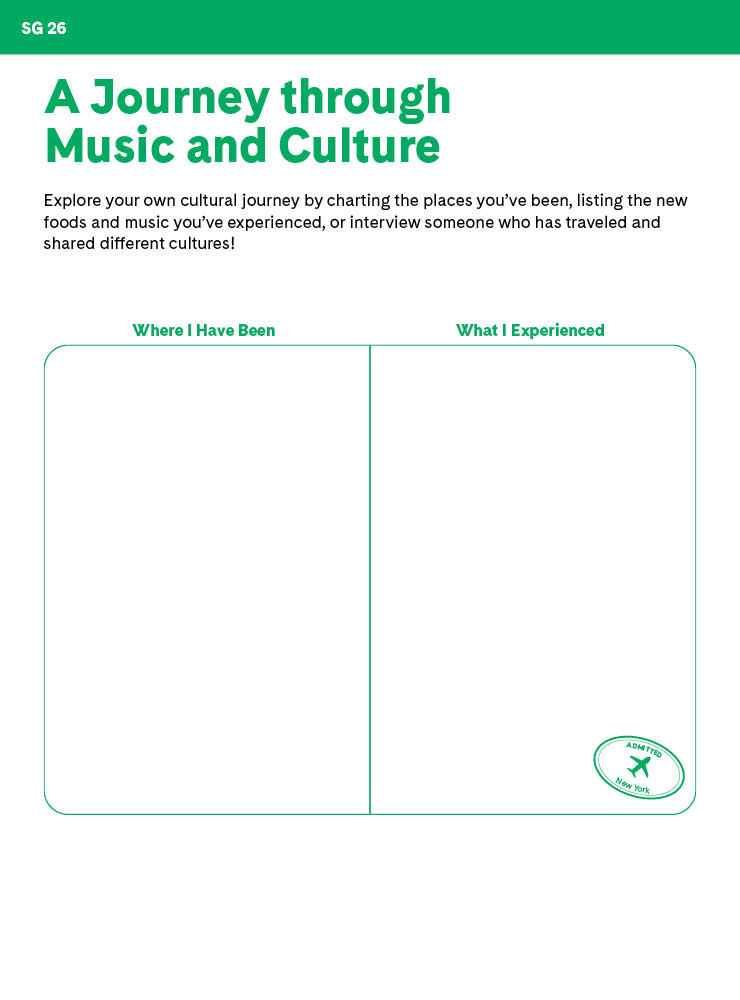
A Journey through Music and Culture
People have always moved from place to place, whether by choice or by force, bringing their music, food, and traditions with them—just like the Sephardi Jews across the lands formerly controlled by the Ottoman Empire. When populations move from place to place and meet each other, there's an exchange and sharing of cultures.
- Explore your own cultural journey by charting the places you’ve been, listing the new foods and music you’ve experienced, or interview someone who has traveled and learned from different cultures!
- List or draw responses using A Journey through Music and Culture (PDF).
- Where have you traveled?
- What is a new food you’ve tried?
- What songs, instruments, or dances have you experienced that come from different places?
- Do you speak more than one language? What other languages have you heard in our classroom, in a song, at a store, or from a friend?
Musical Word Wall
Add the words Ladino and Sephardi to the Musical Word Wall.
Share Your Feedback
Help us improve the Musical Explorers experience by sharing your feedback in a five-minute survey.
Image Credits
Lily by Ally Schmaling; Panoramic view of Mediterranean coast of Turkey, town of Kas and Greek island of Kastellorizo in distance by DPK-Photo / Alamy Stock Photo; Borek (Also Burek) a Turkish pastry filled with cheese or potato or mushroom with black olives by PhotoStock-Israel / Alamy Stock Photo; Lily childhood photo courtesy of artist.